Navigating The Phoenix Housing Market

Welcome to the official blog of Dominion Group Properties—your trusted resource for real estate news, market analysis, and expert guidance across Phoenix, Scottsdale, North Phoenix, Cave Creek, Carefree, and Anthem. Whether you're a home buyer, seller, investor, or planning a relocation within the Valley, our blog delivers timely content to keep you informed.

What We Cover

  • Local Market Trends & Housing Reports: Stay updated with monthly insights on inventory, pricing, and market shifts in Phoenix and the North Valley.
  • Home Buying & Selling Strategies: From financing manufactured homes to pricing historic properties, our articles cover every step of the process.
  • Community & Development News: Learn about upcoming neighborhoods like Desert Hills, emerging job centers, and how primed areas are shaping investment opportunities.
  • Property Management & Landlord Tips: Make informed decisions whether you're leasing, investing, or managing a residential property in Arizona.

Why Our Blog Stands Out

  • Content anchored in real-world market data and local expertise across Phoenix Metro and surrounding regions.
  • Written and curated by Jonathan Baer—broker, licensed loan officer, and real estate advisor with over 30 years’ experience and $240 million in closed transactions in Maricopa County.
  • Blog topics tailored for actionable insights, whether flipping a home in Cave Creek, planning a move to Anthem, or financing a manufactured home in Phoenix.

Bookmark this page and check back regularly for fresh updates, expert commentary, and smart strategies for navigating Arizona’s dynamic real estate market.

About the Author:
Jonathan Baer, Designated Broker and Real Estate Wealth Advisor at Dominion Group Properties, has completed over 1,000 transactions worth more than $240 million across Arizona.


Learn More About Jonathan Baer

July 8, 2026

Navigating the Phoenix Housing Market — July 2026 | Dominion Group Properties


Dominion Group Properties

Navigating the Phoenix Housing Market — July 2026

Pricing discipline decides who sells this summer.

Every month I pull the latest Cromford Report numbers — the most reliable read we have on the Phoenix metro market — and give you a straight assessment of what they mean. The data released July 4th covers the first week of July, and the short version is this: the market is flat, and flat markets reward sellers who price for the buyer pool that actually exists, not the one they wish they had.

By the Numbers — Early July 2026

Metric Jul-26 Jun-26 YoY % MoM %
Active Listings (excl. UCB/CCBS) 24,566 25,488 -4.3% -3.6%
Pending Listings 4,670 4,800 +3.3% -2.7%
Closed Listings (month) 7,257 7,549 +9.2% -3.9%
Avg. Price per Sq. Ft. $302.56 $300.56 +3.2% +0.7%
Median Sales Price $454,990 $455,000 +1.1% 0.0%
Listing Success Rate 69.9% 71.4% +5.2% -2.2%
Days Inventory 132.5 139.2 -8.6% -4.8%
Monthly Dollar Volume $4,540M $4,658M +15.1% -2.5%

What's Actually Happening

Compared to July 2025, nearly every metric looks better — inventory is down, days inventory is down, closed listings are up. Compared to last month, the picture is more mixed, and that's normal seasonality: fewer listings, fewer closings, a slightly lower success rate as the market moves through the slowest stretch of the summer.

The median sales price didn't move at all month-over-month — $455,000 in June to $454,990 in July. Average price per square foot ticked up modestly. That combination tells you pricing is stable, not accelerating. There's no sign of a decline, but there's also no sign of the kind of appreciation that bails out an overpriced listing.

Supply is thinning, which normally favors sellers, but a chunk of that drop is seasonal — some luxury sellers pull their homes in the hottest months and relist in late September rather than compete for a smaller buyer pool. That's a choice, not a market failure, and it's worth keeping in mind if you're deciding whether to list now or wait.

For Sellers

This is the core message this month: the market is flat, and the buyer pool is smaller than normal for this time of year. That doesn't mean you can't sell — it means affordability is doing the work that used to happen on its own. If your home isn't priced to be affordable relative to what's actually competing against it, you will sit. Sellers right now aren't desperate — Days Inventory at 132.5 and a 97.27% closed-to-list ratio both say buyers who transact are paying close to asking. But "not desperate" cuts both ways. Buyers have options and they're using them. Price it right the first time.

For Buyers

If you find the right home at the right price, this is a workable market to buy in. Contract Ratio and Listing Success Rate are both up meaningfully year-over-year, and closed-to-list at 97.27% means sellers are engaging seriously with offers — not holding out for something unrealistic. You should also be able to get reasonable cooperation on financing terms in most transactions right now. Just don't expect sellers to be desperate. Come in with a realistic offer, not a lowball, if you want the home.

Bottom Line

Flat pricing, a smaller-than-normal buyer pool, and sellers who aren't under pressure to give homes away — that's July 2026 in three phrases. Whether you're buying, selling, or holding, the strategy that works in this market is the same one that's worked for 30 years: know the real numbers before you make a move.

Questions about what this means for your specific situation?

623-252-1424  |  jon.baer@dgpaz.com

Book a Call
June 6, 2026

Navigating the Phoenix Housing Market — June 2026 | Dominion Group Properties

Dominion Group Properties · Market Report · June 2026

Navigating the Phoenix Housing Market

Straight talk for buyers, sellers, and investors

Market Overview

The Phoenix housing market is essentially moving sideways in nominal terms — but once you account for inflation, prices are declining in real terms. That’s the realistic read heading into summer 2026.

Supply is ticking down as expected — sellers who couldn’t find buyers in the spring are pulling listings off the market — but demand remains well below its long-term average. The macro picture is complicated: persistent inflation, global uncertainty, the AI economy, and TSMC’s impact on the North Phoenix corridor are all in the mix. Most analysts say the market is “stable.” They’re not wrong on the surface. But stable nominal prices in a 3.8% inflation environment is not stability — it’s quiet, ongoing value erosion.

By the Numbers — Cromford Report, June 1, 2026

Active Listings
25,488
↓ 4.1% vs. last year
Monthly Sales
7,539
↑ 5.9% vs. last year
Median Sale Price
$455K
Flat vs. last year
Avg. $/Sq. Ft.
$300.65
↑ 0.1% vs. last year
Under Contract
8,532
↑ 7.5% vs. last year
Cromford Index
< 90
Below 90 since Jan ’25

The Real Story: Inflation-Adjusted Pricing

At 3.8% annual inflation, that $455,000 median home should be worth $472,290 today just to hold even with the rest of the economy. It’s not. That’s a real-terms loss of roughly $17,290 — quietly eroding seller equity while nominal prices look “stable.”

Supply vs. Demand

SupplyJust above normal
DemandWell below long-term average

Summer heat is naturally pulling unsold listings off the market, reducing inventory — but don’t read that as market strength. Demand simply hasn’t kept pace. Under $1M, buyers hold the negotiating edge. Above $3M, it’s a different story entirely: the true luxury segment$3M+ is exhibiting abnormal strength tied directly to stock market performance at those price points. The premium being paid for high-end homes is as elevated as we’ve seen in years.

Jonathan’s Take

“The market isn’t moving sideways — it’s losing ground to inflation. Stable prices in an inflationary economy means a slow, steady loss of purchasing power. Sellers need to be realistic. Buyers need to be strategic.”

What’s Selling. What’s Sitting.

Updated homes — moving fast, top dollar

Listings with fresh, modern finishes are selling quickly and commanding premium prices. And “updated” means today’s standards — not 2022. Buyer expectations have moved. A kitchen renovated four years ago may already read as dated to today’s buyer.

Dated homes — sitting longer, conceding more

Homes with older finishes are accumulating days on market. To close, sellers are either dropping price, covering buyer closing costs and rate buydowns, or both. This trend is accelerating heading into summer.

Macro Factors Shaping the Market

TSMC Corridor

Semiconductor manufacturing in North Phoenix continues to create localized, structural housing demand — a real economic driver, not speculative appreciation.

Inflation

Running at 3.8% annually. The Fed’s trajectory matters enormously for mortgage rates — and by extension, buyer purchasing power and market velocity.

AI Economy

The AI-driven economic shift is influencing job market confidence and relocation patterns in the Phoenix metro — particularly in tech and financial sectors.

Global Uncertainty

Geopolitical conditions are affecting investor risk appetite and mortgage rate volatility — adding unpredictability to an already complex picture.

A Word for Buyers — The Longer View

Yes, home prices are declining in real terms right now. That’s the short-term reality and buyers should factor it into their negotiations. But the fundamentals of homeownership don’t change based on a single market cycle.

Why buying in Phoenix still makes sense long-term

Every mortgage payment builds equity — rent payments build none. Ownership provides stability that no lease can match. And Phoenix’s long-term trajectory remains strong: the city’s job market is one of the most diversified and resilient in the country, driven by semiconductor manufacturing, financial services, healthcare, and the tech sector. Prices will return to growth. The question for buyers isn’t whether Phoenix will recover — it’s whether you’ll own when it does.

Bottom Line

Sellers: Be realistic about where your home stands relative to updated competition. If finishes are older — even from just a few years ago — price accordingly or prepare to make concessions.

Buyers: You have leverage in most of the market right now — use it. Rate buydowns, seller concessions, and price reductions are all on the table. Be strategic. And remember: the short-term dip in real values is real, but so is the long-term case for owning in Phoenix.

Investors: The $3M+ luxury segment is genuinely strong. Everything else demands careful underwriting. Inflation-adjusted returns matter more than ever — don’t let stable nominal prices lull you into overpaying.

Jonathan Baer — Dominion Group Properties

Designated Broker · Licensed Loan Officer · RE License BR571739000 · NMLS 1904177

623-252-1424 · jon.baer@dgpaz.com · dgpaz.com

Serving Phoenix, Scottsdale, Cave Creek, Carefree, Anthem, New River, Desert Hills & the North Phoenix TSMC corridor.

May 15, 2026

Phoenix Housing Market Update — May 2026 | Dominion Group Properties

Navigating the Phoenix Housing Market — May 2026

Jonathan's take

The standoff between buyers and sellers continues — and I don't see it breaking anytime soon. Sellers are still trying to maximize price, but affordability is the ceiling in the lower and middle-market. To move product, you either lower the price or buy down the rate with closing cost assistance. Simple as that.

Rates are now tied to the price of oil — a relatively new dynamic that emerged with the war. Watch oil, watch rates. What I'm noticing, though, is that buyer fatigue is real. People have been sitting on the sidelines so long that they're finally accepting reality: if you want the house, you're going to pay for it even in a higher-rate environment. "Date the rate, marry the house" applies more than ever — and I'm seeing it play out in the North Valley communities I know best. In Anthem, Cave Creek, and Desert Hills, buyers who've been circling quality properties for months are starting to pull the trigger.

The implication for sellers in those markets: if a buyer is coming off the sideline and committing, that home had better be right. Condition and presentation are not optional. If it's the right house, they will pay. If it isn't, they'll walk.

Cromford market snapshot — May 1, 2026 vs. May 1, 2025

Active listings
25,908
↓ 1.1% year-over-year
+1.2% vs. last month
Pending listings
5,492
↑ 3.1% year-over-year
Under contract
9,746
↑ 7.7% year-over-year
Strong demand signal
Monthly sales
7,719
↑ 5.4% year-over-year
Median sale price
$450K
↑ 1.1% year-over-year
↓ 1.1% vs. last month
Avg $/sq ft
$303
↑ 1.4% year-over-year
↓ 3.4% vs. last month

What the numbers mean for you

Supply peaked late — a negative signal for sellers metro-wide. Active listings are down year-over-year, but the peak arrived later in the season than normal. The typical spring momentum faded faster than expected. If you're a seller and you missed the early spring window, be realistic about where pricing needs to land.
Single-family demand is solid — especially in the North Valley. Anthem continues to attract family buyers drawn to its master-planned infrastructure and price points that still feel accessible relative to inner Scottsdale. Cave Creek and Desert Hills are holding up well for buyers who want acreage, custom builds, and a lifestyle the core valley can't offer. Demand is weakest for condos, townhomes, and anything under $500K metro-wide — but detached single-family in these communities is a different story.
Location still decides who holds the power. Sellers control central and higher-priced corridors. In Cave Creek and Desert Hills — where lot sizes, privacy, and custom finishes drive value — well-priced properties are still finding motivated buyers. Anthem is more nuanced: move-in ready homes in the right neighborhoods sell; anything needing work or priced optimistically is sitting. Buyers control the outer fringes and properties below $500K across the board.
Inflation-adjusted, prices are effectively flat or down. The median is up 1.1% from last year in nominal terms — but when adjusted for inflation, both median price and price per square foot are below year-ago levels. This is the honest read sellers in every market, including Anthem, Cave Creek, and Desert Hills, need to factor into their expectations heading into summer.
Get a straight answer on your specific situation.

Whether you're buying or selling in Anthem, Cave Creek, Desert Hills, or anywhere across the Phoenix metro — book a call and let's talk through what the market actually means for you.

Book a Call
JB

Jonathan Baer — Designated Broker, Dominion Group Properties

30+ years of real estate experience · 1,299+ closed transactions · $309M+ in closed volume · Licensed Broker (BR571739000) & Loan Officer (NMLS 1904177) · Serving Phoenix, Scottsdale, Cave Creek, Carefree, Anthem, New River & Desert Hills.
Learn more about Jonathan →

April 27, 2026

Arizona's Water Supply: What the Next 10 Years Look Like | Dominion Group Properties

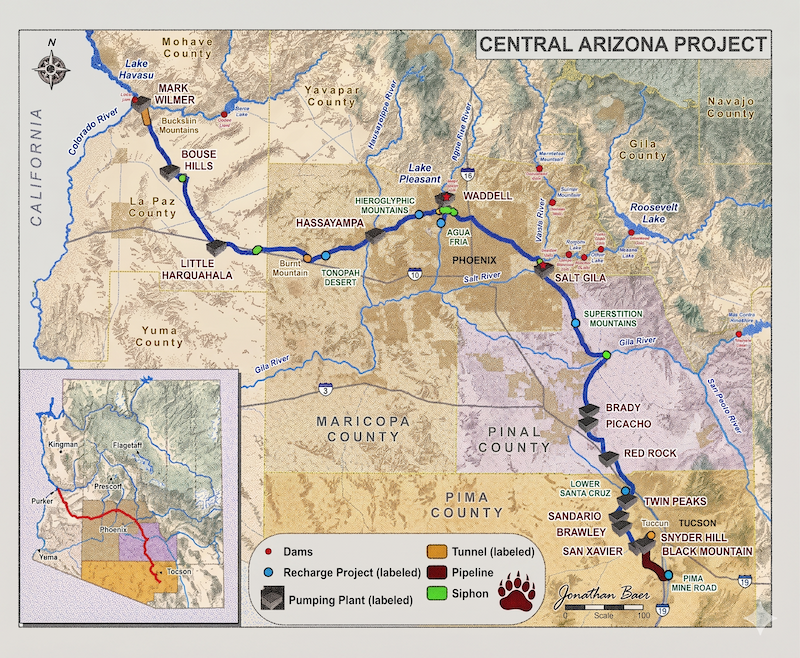
Arizona Project aqueduct map showing the 336-mile water delivery route from Lake Havasu to Tucson across Maricopa, Pinal, and Pima counties

Central Arizona Project — 336-mile aqueduct serving 80% of Arizona's population · Source: CAP
Water & Real Estate · Market Intelligence

Arizona's Water Supply:
What the Next 10 Years Look Like

Where Phoenix gets its water today, what's under threat, and the hard decisions coming before 2035 — straight from the people managing it.

I recently attended a briefing by CAP (Central Arizona Project) and SRP (Salt River Project) — the two agencies managing the majority of metro Phoenix's water. The takeaways matter for anyone buying, selling, or investing in Arizona real estate. Here's what I learned.

Part 01

Where Arizona's Water Comes From Today

Arizona draws from four primary sources. Right now, the mix looks like this:

The Central Arizona Project is the 336-mile aqueduct that carries Colorado River water from Lake Havasu to Tucson — a system that took 20 years and $4 billion to build (1973–1993). It serves 80 percent of Arizona's population across Maricopa, Pinal, and Pima counties, with 54% of its allocation going to municipal partners and 46% to tribal partners.

SRP, formed in 1903, manages a watershed covering one-third of Arizona — running six dams across the Salt and Verde rivers plus 270 ground wells averaging 1,000 feet deep, capable of pumping 2,000–2,500 gallons per minute. Combined, SRP holds 2.5 million acre-feet in recharge facilities.

Scottsdale is a useful benchmark: 72% of its water supply is CAP water. That's not a minor dependency — it's structural. Anthem operates under a 100-year water lease with the Ak-Chin Tribe for its CAP allocation.


Part 02

The Colorado River Problem

The 1922 Colorado River Compact divided water rights between Upper and Lower Basin states based on estimates of 15 million acre-feet annually. The actual long-term average is 12.7 million acre-feet. Over the past five years it's dropped to 11.1 MAF — a compounding shortfall that was baked in from the start.

40M
People dependent on the Colorado River
7
States sharing the river's water
25+
Year mega-drought and counting
36%
Drop in combined Lake Powell & Mead storage

Arizona's normal CAP allocation is 1.6 million acre-feet per year. Under the current Tier 1 shortage declaration, that drops to approximately 1 million acre-feet. This year's projected Colorado River runoff: just 2.78 million acre-feet for the entire system. The Federal government determines delivery amounts for 2027.


Part 03

SRP's Infrastructure Challenges

SRP's Verde River dams — Horseshoe and Bartlett — have lost 25–33% of their storage capacity to sediment buildup. The Verde River Sediment Mitigation Project is still in the feasibility stage, with four options on the table:

Build a New Bartlett Dam

Projected timeline: 2031–2032. Cost estimate: $3.7 billion. Partners include the Town of Cave Creek, Carefree Water Company, City of Phoenix, and City of Scottsdale.

Raise the Height of the Existing Dam

Increase storage capacity within the existing dam footprint at lower cost than new construction.

Dredge Bartlett and Horseshoe

Remove accumulated sediment to restore the dams' original storage capacity without new construction.

Do Nothing

Accept ongoing capacity loss and manage within progressively reduced storage constraints.

East Valley communities benefit from better aquifer access. The west side does not — a geographic divide that will intensify as surface water supplies tighten.


Part 04

Long-Term Solutions — And Their Cost

Five strategic approaches are being pursued simultaneously. None of them are cheap:

Negotiations

Ongoing Upper and Lower Basin talks to establish a new post-2026 operating framework for the Colorado River. No agreement is currently in place.

Augmentation

Identifying entirely new water sources — desalination, atmospheric water, and ocean water transfers are all under state-level discussion.

Efficiency & Conservation

Reducing outdoor water use is the fastest lever available. Outdoor irrigation accounts for the majority of residential water consumption in desert climates.

Reuse / Recycled Water

Advanced Water Purification facilities are operational or coming online between 2027 and 2038. Direct potable reuse is a growing component of the long-term plan.

Aquifer Storage & Recovery

SRP's underground storage facilities — including Granite Reef and New River Aqua Fria — allow excess water from wet years to be banked and drawn down during dry ones. SRP currently holds 2.5 million acre-feet in storage.

The cost trajectory is the number that gets everyone's attention:

That's a roughly 10x increase in cost for augmented supply. That cost lands somewhere — on utilities, on developers, on property owners. The state will need a new revenue mechanism to fund the infrastructure required. It's not a question of if rates rise; it's a question of timeline and how the burden gets distributed.


Real Estate Perspective

What This Means If You're Buying, Selling, or Investing in the Phoenix Metro

Water is becoming a disclosed risk in Arizona real estate — not just a regulatory abstraction. Developments north of Phoenix in New River and Desert Hills rely primarily on groundwater. Communities like Anthem carry a 100-year water lease with the Ak-Chin Tribe through CAP. Scottsdale's 72% CAP dependency means any further shortage tier directly affects a market I work in daily.

The infrastructure investment ahead — whether a new Bartlett Dam at $3.7B, desalination facilities, or expanded water recycling — represents a generational commitment that will shape land values, development potential, and utility costs across the entire region.

Before buying in any submarket from Cave Creek to the TSMC corridor in North Phoenix, water security should be part of your due diligence conversation. I make it part of mine. That's not alarmism — it's what 30 years of closed transactions in this market has taught me to watch.

Have questions about a specific area?

I work across the Phoenix metro and North Scottsdale submarkets. Water supply, infrastructure timelines, and land use are part of every property conversation I have.

Sources: Central Arizona Project (CAP) briefing; Salt River Project (SRP) briefing. Data reflects information shared at a 2025 industry water security meeting.

For ongoing water news: knowyourwaternews.com · centralarizonaproject.com · protectingarizonaslifeline.com

Jonathan Baer · AZ Broker BR571739000 · NMLS 1904177 · Dominion Group Properties · Foothills Mortgage Group LLC

© 2025 Dominion Group Properties · dgpaz.com · Phoenix, AZ

Jonathan Baer · AZ Broker BR571739000 · NMLS 1904177 · Back to Blog

April 18, 2026

Phoenix Housing Market Update April 2026

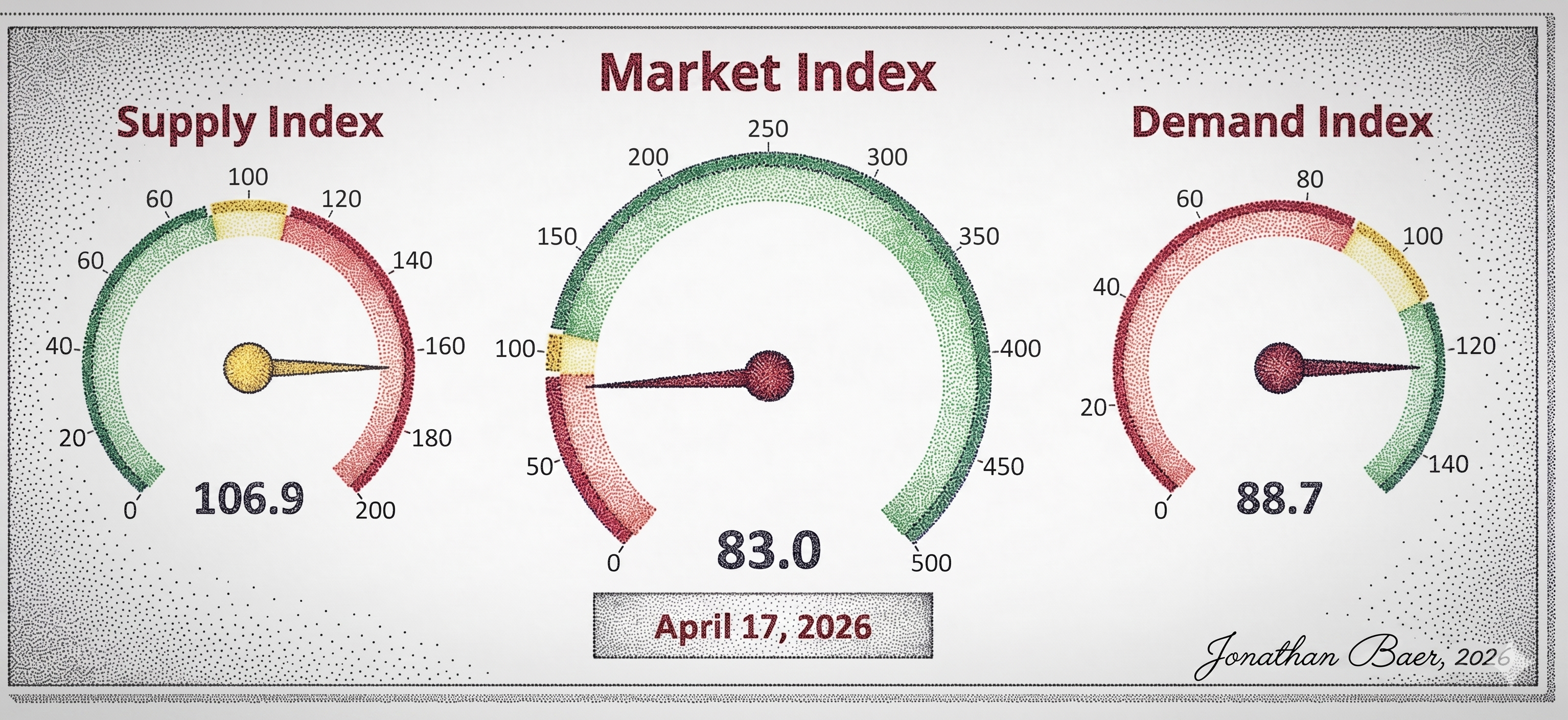
April 2026 Market Gauges


Dominion Group Properties  ·  dgpaz.com

Phoenix Housing Market Update

Median Sales Price

$455,000

↓ 1.0% yr/yr  ·  ↑ 1.1% mo/mo

Avg. Price / Sq. Ft.

$314.14

↑ 1.1% yr/yr  ·  ↓ 0.5% mo/mo

Active Listings

25,571

↑ 2.3% yr/yr

Monthly Sales

7,719

↑ 11% yr/yr

Pending Listings

5,540

↑ 5.0% yr/yr

Under Contract

9,799

↑ 7.5% yr/yr

What the data says

The April 2026 Cromford Report paints a picture of a market that is holding — but not running. On the surface, the headline numbers look respectable: 7,719 closings in March, up 11% from a year ago, with listings under contract up 7.5% year-over-year and showings reaching their highest level in 12 months. The median sales price sits at $455,000, down just 1% from last year. Cromford's own analysts called it "holding up well."

But dig into the mid-month update and a different story starts to emerge. The average sales price per square foot fell a sharp 3.4% between March 15 and April 15 — from $318.45 to $307.72 — far beyond the modest 1.1% decline that was forecast. Cromford attributes the volatility largely to an ultra-luxury surge in early 2026 that pulled average figures higher, followed by a pause in those closings mid-month. The median held steady. The average swung wildly. That divergence matters.

Distress levels remain low by historical standards, but Cromford is noting a slow upward trend in pre-foreclosure activity — currently 2.0% of pending listings. Worth watching.

Cromford May 15 Forecast — Avg. Price / Sq. Ft.

$303.89  mid-point (↓ 1.2%)

90% confidence range: $297.81 – $309.97  ·  Outcome depends heavily on luxury closings

My take: this is a buyers market

The headline numbers flatter the market more than it deserves. Strip out the high-end closings that have skewed the averages upward, and what you have is a market that is quietly deteriorating in terms of price. I'll say it plainly: we are in a buyers market.

Demand is muted. Mortgage rates stubbornly hovering near 6.45%, combined with persistent inflation, have made buyers cautious. This isn't a lack of desire to buy — it's a confidence problem. Affordability is stretched, and economic uncertainty is doing what it always does: it makes people pause at exactly the moment they'd otherwise act.

The key dynamic right now: Sellers can address affordability — through price reductions, rate buydowns, or concessions. They cannot address uncertainty. That distinction matters enormously when pricing a home today.

Sellers are still coming to market, and some are pricing as if it's 2022. It isn't. Inventory is rising. Homes that are updated, well-presented, and priced correctly are still selling — often with multiple offers. Homes that are not are sitting, collecting days on market, and eventually receiving lower offers than they would have gotten with disciplined pricing on day one. The market is grading on a curve right now, and the curve is steep.

The low end of the condo market deserves a special mention. High HOA fees and escalating reserve requirements are actively deterring buyers. Many of these units are genuinely more attractive to rent than to own at current prices. If you own one of these properties, understand that your buyer pool is narrow and your competition is rental income.

For buyers, this environment — while frustrating — represents the best negotiating position in several years. Rate buydowns, seller concessions, and genuine price flexibility are on the table in ways they simply were not 18 to 24 months ago.

Bottom line

Price appreciation has gone sideways. The luxury market is masking softness in the broader market. Inventory is building. Affordability and uncertainty are the twin forces suppressing demand — and sellers can only control one of them. If you're thinking about buying or selling in the Phoenix metro, now is the time to have a frank conversation about strategy, not just price.

I'm Jonathan Baer. I've closed over 1,299 transactions and $309 million in volume across Phoenix, Scottsdale, Cave Creek, Carefree, Anthem, and the North Phoenix/TSMC corridor. I've seen this market in many conditions. This one requires eyes wide open — on both sides of the transaction.

Jonathan BaerReal Estate Wealth Advisor  ·  Dominion Group Properties
AZ Broker BR571739000  ·  NMLS 1904177  ·  Foothills Mortgage Group LLC
dgpaz.com  ·  jon.baer@dgpaz.com  ·  623-252-1424

Market data sourced from the Cromford Report, utilizing ARMLS and Maricopa County Recorder data (April 2026). Statistics reflect all areas and types within the ARMLS database. Past performance is not indicative of future results. This report is for informational purposes only and does not constitute legal, financial, or investment advice. Jonathan Baer is licensed as a real estate broker in the State of Arizona (BR571739000) and as a mortgage loan originator (NMLS 1904177) through Foothills Mortgage Group LLC.

April 11, 2026

How Long Do Water Wells Last in Arizona?

How Long Do Water Wells Last in Arizona? | Water Well Drilling Phoenix, AZ

How Long Do Water Wells Last in Arizona?

By Jonathan Baer, Dominion Group Properties

Water wells are a crucial lifeline for many homes and businesses in Arizona, particularly in our rural North Valley communities. Whether you are in New River, Desert Hills, or Cave Creek, your well provides everything from drinking water to irrigation. However, understanding the lifespan of a water well is critical for long-term property value and operational stability.

Considering a Property with a Well?

Buying a "well property" in Arizona requires a specific set of due diligence steps that differ from standard city-water homes. Before you sign, read our essential expert guide:

The Landlord & Homeowner's Guide to Buying Homes with Water Wells in Arizona

What is the Real Lifespan of a Water Well?

The average lifespan of a water well in Arizona typically ranges between 30 to 50 years. While some properly maintained wells can last much longer, factors like groundwater table shifts in the Phoenix basin and equipment neglect can significantly shorten that window. If you are researching water well drilling in Phoenix, AZ, longevity starts with the quality of the initial install.

4 Key Factors Influencing Longevity

1. Well Construction and Materials

Your casing material is your first line of defense. Steel casings are durable but prone to corrosion in high-mineral Arizona water. PVC and fiberglass are corrosion-resistant but can become brittle or damaged by extreme temperature fluctuations over decades.

2. Arizona’s Unique Geological Conditions

Geology is destiny for a well. Wells tapping into deeper, stable aquifers generally last longer. However, our dry climate and occasional droughts can lower the water table, potentially requiring you to deepen an existing well to maintain access.

3. Maintenance Practices

Neglect is the #1 well-killer. Regular well maintenance should include:

  • Annual Water Quality Testing: Checking for bacterial or mineral changes.
  • Mechanical Inspections: Monitoring the well pump for wear and tear.
  • Well Cleaning: Removing sediment buildup to maintain flow efficiency.

4. Usage and Overuse

Overtaxing a well in an arid environment can lead to declining water quality and a faster drop in the water table. Efficient water management isn't just good for the environment; it protects the physical integrity of your well.

Signs Your Well Needs Professional Attention

Don't wait for the water to stop running. Watch for these red flags:

  • Reduced Water Pressure: Could indicate a pump failure or a declining water table.
  • Cloudy or Odorous Water: Often a sign of casing cracks or contamination.
  • Surging Energy Bills: A pump that is struggling or cycling too often will spike your utility costs.

Jonathan’s Takeaway:

In 30 years of Arizona real estate, I've seen a lot of "well panics" that could have been avoided with simple preventative maintenance. Whether you are maintaining a legacy family well or looking at well and drilling near me for a new build, the goal is the same: Protect the source. If you’re buying in an area like New River or Desert Hills, make sure your Realtor actually knows how to read a well yield report. You following me?

Search Well-Water Properties in North Phoenix & Cave Creek

April 11, 2026

Buying a Home on a Well in Arizona: What Every Buyer Needs to Know


Arizona Real Estate Guide

Buying a Home on a Well in Arizona:
What Every Buyer Needs to Know

There is something genuinely appealing about owning property on a private well in the Arizona high desert. No monthly water bill from a municipality. No infrastructure fees. A sense of self-sufficiency that fits the landscape perfectly. If you're searching for homes in Desert Hills, property in New River, or real estate in Cave Creek, chances are strong that any home on acreage comes with a well rather than a city water connection.

But well ownership is not without complexity. Water is infrastructure — and when you buy a home on a well, you are buying that infrastructure too. Knowing what questions to ask and what to look for before you close can save you from significant expense and frustration after you take possession. This guide walks you through everything that matters.

1. Why Well Properties Deserve Extra Due Diligence

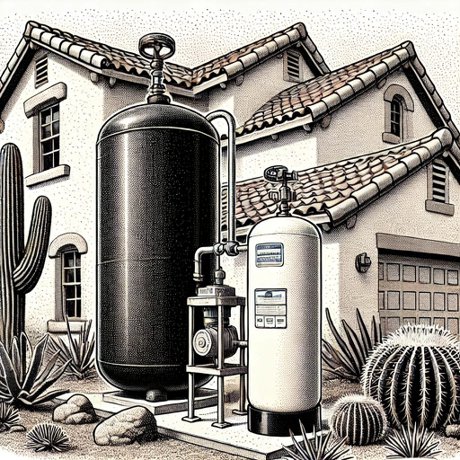
When you purchase a home on city water, the utility company maintains the system from the main line to your meter. If something goes wrong with supply, you call them. On a well property, that system — from the casing in the ground to the pump, pressure tank, storage tanks, and filtration equipment — belongs entirely to you.

This is not a reason to walk away from a well property. Hundreds of thousands of Arizona homeowners live very comfortably on well water. It is, however, a reason to go into the transaction with your eyes fully open and to conduct thorough due diligence during your inspection period. A skilled agent who knows rural property — like Jonathan Baer at DGPAZ — will help you identify the right professionals and ask the right questions before you are committed.

2. Start With the Permit Number and Well Records

Every legally constructed well in Arizona is required to have a permit on file with the Arizona Department of Water Resources (ADWR). The well permit number is your entry point into the documented history of that well. With it, you can pull the well completion report — which includes the driller's log, the geological layers encountered during drilling, the depth of the well and perforated casing, the static water level at the time of drilling, and the initial yield estimate.

If a seller cannot produce a permit number, or if no record exists on file with ADWR, that is a serious red flag. It does not automatically mean the well is bad — but it means there is no documentation of how it was constructed or whether it meets state standards. Unpermitted wells exist in rural Arizona, some decades old, and they carry meaningful legal and functional risk.

Pro Tip You can search ADWR's wells registry at wellregistry.azwater.gov using the permit number, well registry number, or the property's section-township-range location. Ask your REALTOR to help pull this data early in the process — well before inspection deadlines arrive.

3. Well Depth and Gallons Per Minute

Two numbers define a well's fundamental capability: how deep it is and how much water it can produce.

Well depth matters because the water table in many parts of the Arizona high desert has been declining over decades due to population growth and sustained drought conditions. A well drilled to 400 feet with 200 feet of water above the pump in 1985 may have considerably less head pressure today. If the static water level has dropped to within 50 feet of the pump intake, you have a well that could be in trouble — and one that may require deepening or pump replacement sooner than expected.

Gallons per minute (GPM) is the sustained yield of the well. For a typical single-family home, you need a minimum of 3 to 5 GPM for reliable daily use. A well producing less than 3 GPM is not necessarily disqualifying, but it typically means the property requires storage tanks to buffer peak demand — and that is an additional system to evaluate and maintain.

Request a flow test — also called a pump test or yield test — as part of your inspection. A licensed well pump contractor will run the pump for a sustained period and measure actual output. This is one of the most valuable inspections you can commission on a well property.

4. Age of the Pump and Pressure Tanks

The submersible pump at the bottom of your well is a mechanical device with a finite lifespan. Under normal operating conditions, a quality submersible pump can last 10 to 15 years. However, running in water with high mineral content — common in the Desert Hills, New River, and Cave Creek corridors — can accelerate wear. Always ask about the age of the pump and request any service records available.

Replacing a submersible pump in a deep well is not a trivial expense. Pulling a pump from 400 to 600 feet of depth requires a licensed pump contractor with a crane truck. Budget $2,000 to $5,000 or more depending on depth, pump size, and current labor rates. If a pump is already 12 to 15 years old, factor potential near-term replacement into your offer price.

Pressure tanks — the bladder or diaphragm tanks that maintain household water pressure — are typically above-ground components and easier to replace. They have a lifespan of roughly 5 to 15 years depending on water chemistry and cycling frequency. A waterlogged pressure tank will cause the pump to short-cycle, dramatically reducing pump life. Inspect the pressure tank during the home inspection and listen for tell-tale rapid pump cycling.

Watch Out An aging pump combined with a waterlogged pressure tank is a double problem. Short-cycling stresses the motor windings and can cause premature pump failure. If you see signs of both issues, get a pump contractor on-site before close — not after.

5. Private Well vs. Shared Well

A private well is simple: one wellhead, one pump, one property. You own it entirely. A shared well — also called a community or cooperative well — serves two or more parcels from a single wellhead, with shared costs and shared decision-making.

Shared wells are relatively common in rural Arizona, particularly on parcels subdivided from larger tracts before modern infrastructure planning. They can work perfectly well for decades. But they require a critical piece of documentation: a recorded shared well agreement.

A proper shared well agreement covers who manages the well, how operating and maintenance costs are split, what the process is for major repair or replacement decisions, who holds the insurance, and what happens if one party wants to drill their own well and exit the arrangement. Without this document recorded with the county, you are relying entirely on neighborly goodwill — and that can evaporate quickly when a $4,000 pump replacement bill arrives.

Critical Due Diligence Item If the property is on a shared well, make obtaining and reviewing the recorded shared well agreement a condition of your purchase. No agreement on file? That is a negotiating point — and possibly a dealbreaker — not something to sort out after closing.

Also ask: who is the designated well manager? Is there a formal process for maintenance decisions? Has the cost-sharing arrangement ever created conflict between the parties? An experienced agent will know how to navigate these conversations diplomatically and flag what is missing before you are under contract.

6. Storage Tanks and Hauled Water

Some rural Arizona properties supplement their well supply with above-ground storage tanks — large polyethylene or fiberglass cisterns, often 2,500 to 10,000 gallons in capacity — that hold water to buffer against low-yield wells or high-demand periods.

In some cases, water may also be hauled to the site by truck and pumped into these storage tanks. Hauled water is a completely viable lifestyle choice for many rural homeowners, but it carries ongoing costs — typically $0.10 to $0.30 per gallon delivered plus the delivery charge. If a property relies on hauled water, understand the frequency of deliveries required and build a realistic annual cost picture before you make an offer.

Inspect any storage tanks for structural integrity, evidence of algae or contamination, proper venting and covers, and the plumbing connecting them to the home's pressure system. Old, cracked, or improperly sealed tanks can introduce their own water quality issues independent of the well itself.

7. Water Quality Testing

A water quality test is not optional on a well property — it is essential. Even if the well has been in service for years and the current owners report no issues, you have no way of knowing what is actually in your water without testing it.

At minimum, request a comprehensive potable water test from a state-certified laboratory. A basic panel covers coliform bacteria, nitrates, pH, hardness, and common metals. In areas with known mineral complexity or historic land use, an expanded panel that includes arsenic, uranium, fluoride, and specific heavy metals is well worth the additional cost — typically $150 to $400 for a thorough report.

Water Quality Test — What to Request
  • Total coliform and E. coli bacteria
  • Nitrates and nitrites
  • pH and total hardness
  • Total dissolved solids (TDS)
  • Arsenic
  • Uranium
  • Fluoride
  • Iron and manganese
  • Sulfates
  • Lead and copper
  • Volatile organic compounds (VOCs) — especially if near historic industrial or mining activity

Results are measured against EPA Maximum Contaminant Levels (MCLs). Your certified lab report will flag any parameters that exceed those thresholds. Armed with that data, you — with guidance from a water treatment specialist — can determine what remediation is needed and what it will cost.

8. Mining Residuals in Desert Hills, New River & Cave Creek

Here is something important that many buyers don't know going in: elevated mineral levels and residuals from historic mining activity are common in the groundwater of the Desert Hills, New River, and Cave Creek areas. This is a geological reality of the region — not a sign that something has gone wrong with your specific well.

The greater North Phoenix high desert sits atop terrain that saw significant mining activity — primarily gold, silver, and copper — throughout the late 19th and early 20th centuries. The tailings and mineralized rock from that era have, over generations, influenced local groundwater chemistry. As a result, well water in these communities commonly shows elevated levels of minerals including arsenic, uranium, manganese, and iron compared to urban municipal water supplies.

The Good News Elevated mineral levels in Desert Hills, New River, and Cave Creek are extremely common and very well understood. They are not the end of the world — and they do not disqualify a property from being a wonderful home. They simply mean you will likely need an appropriate filtration system, and knowing that going in lets you plan and budget for it correctly.

The key is to know your specific numbers before you close, not after. A water quality test gives you the exact data you need. If results show elevated arsenic, the solution is a properly sized point-of-use reverse osmosis system or whole-house treatment — not panic. Thousands of families drink their well water safely in these communities every day with appropriate filtration in place.

Working with an agent who understands local water conditions is invaluable. Browse Desert Hills homes for sale, New River properties, and Cave Creek real estate — and let's talk about what due diligence looks like for any property that interests you.

9. What Happens When Well Water Quality Is Poor

If your water quality test reveals parameters that exceed EPA MCLs, you have real options. First, distinguish between aesthetic issues and health-based issues. Elevated iron or manganese will stain your laundry and give water an unpleasant taste and color — that is an aesthetic problem with straightforward filtration solutions. Elevated arsenic, uranium, or bacteria are health-based concerns that require more robust treatment and more careful consideration.

For health-based exceedances, your choices typically include: negotiating a seller credit or price reduction to fund installation of a certified treatment system; requiring the seller to install and certify a system as a condition of closing; or, in cases where contamination is severe and remediation is cost-prohibitive, exercising your right to exit during the inspection period.

Most well water quality issues in the Desert Hills, New River, and Cave Creek corridor fall into the "manageable with appropriate treatment" category. A qualified water treatment specialist — certified, not just a salesperson — can review your test results and give you an honest assessment of what treatment looks like and what it costs.

10. Home Filtration Systems

Once you know what is in your water, you can choose the right tool for the job. The filtration landscape breaks down into two main approaches.

Whole-House (Point of Entry) Systems

These treat all water entering the home — every faucet, shower, appliance, and hose bib. Common components include a sediment pre-filter, a water softener or ion exchange system for hardness and some metals, and iron or sulfur filters where those parameters are elevated. Whole-house systems protect plumbing and appliances and provide treated water throughout. They do not always reduce contaminants like arsenic or uranium to drinking-water-safe levels on their own.

Point-of-Use Drinking Water Systems

Under-sink reverse osmosis (RO) systems treat water at a specific tap — typically the kitchen sink — to very high standards. A quality RO system reduces arsenic, uranium, nitrates, fluoride, heavy metals, and most other contaminants to well below EPA MCLs. They produce 50 to 100 gallons per day of treated water and are ideal for drinking and cooking. Many well-water households in the high desert run a whole-house softener for appliances and an under-sink RO for drinking water — and they are very satisfied with the combination.

Pro Tip Have your water test results evaluated by a WQA (Water Quality Association) certified professional before purchasing any treatment equipment. The right system depends entirely on your specific water chemistry — what works for a neighbor two lots over may not be what you need.

11. The Water Table — Is Your Well Deep Enough?

Arizona is not getting wetter. The combination of sustained drought, increased groundwater extraction, and climate variability has caused water table levels to decline in many parts of the state over the past several decades. This is documented hydrogeological reality — and it is manageable, provided you buy a well drilled to an appropriate depth and positioned in a relatively stable part of the local aquifer.

Before closing on a well property, ask about the current static water level and compare it to what was documented on the original well completion report. If the static level has dropped significantly since drilling, that is meaningful data. Your well pump contractor can tell you whether there is meaningful buffer between today's water level and the pump intake — and whether the well is positioned to remain viable under projected future conditions.

The Arizona Department of Water Resources publishes groundwater level data for monitoring wells throughout the state. For areas like Cave Creek, Desert Hills, and New River, a knowledgeable agent or hydrogeologist can help interpret what the regional trend data means for a specific property on your shortlist.

A general rule: wells drilled deeper are more resilient to water table fluctuations than shallow wells. A 600-foot well in a productive aquifer is generally more future-resistant than a 200-foot well in a shallower formation — though geology varies considerably across even short distances in this terrain, and local expertise matters enormously.

12. The Real Cost of Well Ownership

Let's be clear about something: water from a well is not free. It is common to hear "no water bill" used as a selling point for rural properties, but that framing is misleading. What you don't have is a monthly municipal water bill. What you do have is a set of ongoing costs that, in aggregate, represent your real water expense. Understanding those costs upfront is part of being a prepared buyer.

Ongoing Well Ownership Costs to Budget For
  • Electricity: Running a submersible pump, especially in a deep well, uses meaningful power. Expect $30 to $100+ per month depending on depth and household usage.
  • Annual water quality testing: Best practice is to test at least annually. Budget $150 to $400 per test depending on panel breadth.
  • Pressure tank maintenance: Annual air charge check plus eventual tank replacement every 7 to 15 years ($300 to $800 installed).
  • Filtration system maintenance: Filter cartridge replacements, softener salt, RO membrane replacement every 2 to 5 years. Budget $200 to $600 annually depending on your setup.
  • Pump inspection and service: Periodic inspection by a licensed contractor every 3 to 5 years; eventual pump replacement ($2,000 to $5,000+ depending on depth).
  • Storage tank maintenance: Periodic inspection, cleaning, and eventual replacement where applicable.
  • Hauled water supplement (if applicable): Variable, but can run $500 to $2,000+ annually if relied upon regularly.
  • Emergency reserve: Maintain a cash reserve for unexpected pump failures or water quality events. $2,000 to $3,000 is a reasonable starting point.

When you add it all up, responsible well ownership typically costs $800 to $2,500 per year in routine operating and maintenance costs, plus periodic capital replacement expenses. That is real money — and it belongs in your budget from day one, not as a surprise after you've closed.

None of this should scare you away from a well property. The communities of Desert Hills, New River, and Cave Creek are home to thousands of families who live very happily on well water. The key is going in informed, buying the right property, and maintaining the system responsibly.

That is exactly what I help my buyers do. I'm Jonathan Baer, and rural Arizona real estate — including well properties throughout the North Phoenix high desert — is a specialty I've built over years of working in these communities. Let's find the right property together.


Frequently Asked Questions

What documents should I ask for when buying a home on a well in Arizona?
Request the well permit number, well completion report (showing depth, casing details, and driller's log), any available water quality test results, and — if it's a shared well — a copy of the recorded shared well agreement. You can also search the ADWR well registry online at wellregistry.azwater.gov.
How many gallons per minute should a well produce in Arizona?
For a single-family home, a minimum of 3 to 5 gallons per minute (GPM) is generally considered adequate for reliable daily use. Wells producing less than 3 GPM are not automatically disqualifying, but they typically require storage tanks to buffer peak demand. A licensed well pump contractor can conduct a flow test during your due diligence period to measure actual, sustained output.
Is high mineral content or mining residuals in Arizona well water dangerous?
Elevated mineral levels and residuals from historic mining activity are common in areas like Desert Hills, New River, and Cave Creek — and they are extremely well understood. They are not automatically dangerous or disqualifying. Many buyers address these parameters with whole-house filtration or under-sink reverse osmosis systems. A certified water quality test identifies exactly what is present and drives the right filtration choice.
What is a shared well agreement and why does it matter?
A shared well agreement is a recorded legal document outlining how two or more property owners share access to, maintenance responsibilities for, and costs associated with a common well. It should identify a designated well manager, spell out cost-sharing formulas, and address what happens if one party wants to drill their own well. Buying without a properly recorded agreement is a significant legal and practical risk.
What does it cost to maintain a well in Arizona?
Responsible well ownership typically costs $800 to $2,500 per year in routine operating and maintenance expenses — including electricity, annual water quality testing, filtration upkeep, and periodic professional inspections. Pump replacement runs $2,000 to $5,000 or more depending on depth. Maintaining a cash reserve for unexpected repairs is strongly advisable from day one.
How do I know if the water table is dropping in areas like Desert Hills or Cave Creek?
The Arizona Department of Water Resources (ADWR) maintains publicly accessible groundwater monitoring data. A licensed well contractor or hydrogeologist familiar with local geology can compare current static water levels against the original completion report, giving you a clear picture of how conditions have changed and what that means for long-term viability.
What filtration system should I use for Arizona well water?
The right system depends entirely on your specific water quality test results. Common solutions include whole-house sediment pre-filters, water softeners for hardness, iron and sulfur filters, and under-sink reverse osmosis for drinking water where health-based contaminants are present. Always have results evaluated by a WQA-certified professional before investing in any equipment.
What happens if my well water quality test reveals problems?
You have real options. Most issues in the Desert Hills, New River, and Cave Creek area are manageable with appropriate treatment. You can negotiate a seller credit to fund remediation, require the seller to install a certified system before close, or — in cases of severe contamination — exercise your right to exit during the inspection period. Conducting the test during due diligence is everything.

Ready to Find Your Arizona Property?

Whether it's a private well in Desert Hills, acreage in New River, or a Cave Creek retreat — let's talk about your goals and what smart due diligence looks like for the properties you have in mind.

© DGPAZ — Jonathan Baer, REALTOR® · Serving Desert Hills, New River, Cave Creek & the greater North Phoenix area.

March 14, 2026

Investment Properties Near TSMC: Where Smart Money Is Going: Dominion Group Properties


Dominion Group Properties

Investment Properties Near TSMC: Where Smart Money Is Going

By Jonathan Baer, Dominion Group Properties


Why Investors Are Watching North Phoenix

Major economic developments often reshape real estate markets. The semiconductor expansion underway in north Phoenix is one of those rare moments when employment growth, infrastructure investment, and housing demand converge.

Taiwan Semiconductor Manufacturing Company’s large-scale facility has already begun attracting engineers, technicians, suppliers, and support industries to the region. As thousands of professionals begin relocating to Phoenix for TSMC, demand for housing, both for purchase and rental, continues to grow.

For investors evaluating investment properties near TSMC Phoenix, the opportunity lies in identifying neighborhoods positioned to benefit from long-term employment growth. Communities close to the semiconductor campus are becoming focal points for TSMC Arizona real estate, particularly those offering modern homes, convenient commuting routes, and strong lifestyle amenities.

Understanding where demand is forming can help investors make informed decisions in the rapidly evolving North Phoenix semiconductor housing market.

Why the Semiconductor Industry Attracts Real Estate Investment

Large technology investments tend to influence residential real estate in several ways. Semiconductor manufacturing facilities employ a diverse workforce, ranging from highly specialized engineers to operational staff and management teams. Many of these professionals arrive from outside Arizona.

When large numbers of workers relocate, several housing trends usually appear.

  • Growing demand for rental housing
    Many professionals begin with temporary accommodations before committing to homeownership. This often increases interest in rental properties near employment centers.
  • Strong purchasing power among buyers
    Technology professionals frequently enter the housing market with stable, high-income positions, which supports long-term demand for quality homes.
  • Expansion of surrounding communities
    When job growth accelerates, nearby neighborhoods often experience increased development and infrastructure improvements.

For these reasons, investors frequently look toward areas surrounding major employment hubs when considering real estate investment opportunities.

North Phoenix: The Center of Semiconductor Housing Demand

The semiconductor campus sits within the northern corridor of Phoenix, an area already known for residential growth and master-planned communities.

This region offers several advantages for buyers and renters connected to the technology sector:

  • Easy access to Interstate 17 and Loop 101
  • Expanding retail and entertainment centers
  • Modern residential developments
  • Access to outdoor recreation areas in the Sonoran Desert

Because of these factors, the northern portion of the city is emerging as a key location for property investment management strategies focused on technology-driven housing demand.

Neighborhoods Investors Are Targeting Near TSMC

Norterra

Norterra is one of the closest residential areas to the semiconductor facility. The neighborhood has experienced rapid development over the past decade, featuring new homes, shopping districts, and entertainment options.

Investors are drawn to Norterra because:

  • Commutes to the semiconductor campus are relatively short
  • New construction homes attract relocating professionals
  • Retail areas like The Shops at Norterra support lifestyle convenience

For many investors, Norterra represents one of the most active areas within the TSMC Arizona real estate market.

Desert Ridge

Desert Ridge combines suburban living with urban amenities. Located near Loop 101, it offers strong connectivity across the Phoenix metropolitan area.

This community attracts technology professionals because of:

  • Access to Desert Ridge Marketplace and CityNorth
  • Newer residential developments
  • Proximity to healthcare and corporate employers

Homes in Desert Ridge often appeal to buyers transitioning from rental housing into ownership after relocating to Phoenix.

Anthem

Anthem sits slightly north of the semiconductor campus and remains one of the most established master-planned communities in the region.

Investors frequently consider Anthem because the neighborhood offers:

  • Larger homes and family-oriented communities
  • Extensive parks and recreation facilities
  • Long-term stability in the housing market

As more professionals bring families to Arizona, areas like Anthem continue to attract interest in the north Phoenix semiconductor housing market.

Tramonto

Tramonto offers scenic desert surroundings while still maintaining convenient access to Interstate 17.

Investors exploring opportunities in this community often highlight:

  • Competitive home prices compared with some urban areas
  • Access to hiking trails and outdoor recreation
  • Community pools and neighborhood amenities

These features can appeal to professionals seeking a quieter residential environment close to the semiconductor corridor.

Stetson Valley

Stetson Valley sits within a scenic section of north Phoenix surrounded by mountain preserves and desert landscapes.

The neighborhood attracts attention because it offers:

  • Modern homes with open floor plans
  • Quiet residential streets
  • Convenient access to commuting routes

For investors targeting long-term property appreciation, Stetson Valley presents a combination of lifestyle appeal and steady housing demand.

Rental Demand Around the Semiconductor Corridor

Not every professional relocating to Phoenix immediately purchases property. Some workers prefer to rent during their first year while they explore neighborhoods and evaluate long-term plans.

This trend creates opportunities for investors interested in rental property management strategies.

Common rental demand sources include:

  • Engineers relocating from international offices
  • Contractors supporting the semiconductor supply chain
  • Executives assigned to short-term projects
  • Support staff entering the technology workforce

As semiconductor operations expand, rental housing demand may continue to rise across communities surrounding the campus.

Long-Term Growth Potential for Phoenix Real Estate

Phoenix already hosts a diverse economy that includes technology, healthcare, manufacturing, and aerospace industries. Major employers such as Intel Corporation, Honeywell Aerospace, and Banner Health contribute to the region’s economic stability and job growth.

The addition of a major semiconductor manufacturing hub strengthens the city’s reputation as a growing technology center.

For real estate investors, this type of economic diversification often supports steady housing demand over time. Areas connected to technology employment centers frequently benefit from increased interest in both homeownership and rental property investment.

Evaluating Investment Properties Near TSMC

Investors considering the TSMC Arizona real estate market typically examine several factors before purchasing property.

  • Commute accessibility
    Neighborhoods with convenient freeway access often attract relocating professionals.
  • Housing inventory
    Communities offering newer homes or modern layouts may appeal to technology employees.
  • Local amenities
    Retail districts, restaurants, parks, and schools can influence where renters or buyers choose to live.
  • Future development plans
    Infrastructure expansion or new residential construction may influence property values.

Working with a knowledgeable real estate agent, real estate advisor, or property consultant can help investors evaluate opportunities, analyze the local housing market, and identify properties aligned with long-term investment goals.

Frequently Asked Questions

Are investment properties near TSMC a good opportunity?
Large employment centers often increase housing demand in nearby communities. As semiconductor manufacturing expands in Phoenix, interest in residential properties surrounding the campus continues to grow.

Which neighborhoods are closest to the TSMC plant?
Several communities in north Phoenix—including Norterra, Desert Ridge, Anthem, Tramonto, and Stetson Valley—offer convenient commuting routes and access to modern housing.

Will rental demand increase near TSMC?
Many professionals relocating for new positions begin by renting before purchasing property, which can create opportunities for investors focused on rental housing.

Local Insight from Dominion Group Properties

At Dominion Group Properties, the focus is on helping buyers and investors navigate the Phoenix housing market with practical guidance and clear market insight. The firm provides support for individuals exploring residential purchases, investment opportunities, and property management across north Phoenix and surrounding communities.

With decades of experience in Arizona real estate, the team works closely with clients to evaluate opportunities and develop strategies aligned with long-term goals.

Learn More About Jonathan Baer

If you would like to learn more about working with Jonathan Baer and Dominion Group Properties, visit the page below for additional information.

Meet Jonathan Baer, Designated Broker of Dominion Group Properties

March 14, 2026

What TSMC’s $52 Billion Capital Spend Means for Phoenix Housing Demand: Dominion Group Properties


Dominion Group Properties

What TSMC’s $52 Billion Capital Spend Means for Phoenix Housing Demand

By Jonathan Baer, Dominion Group Properties


Why TSMC Is Reshaping the Phoenix Housing Market

Taiwan Semiconductor Manufacturing Company has committed $52 billion in capital investment to its semiconductor campus in north Phoenix. The project represents one of the largest foreign investments in United States manufacturing and is rapidly transforming the region’s economic landscape.

For the Phoenix housing market, the implications are significant.

Thousands of engineers, technicians, executives, and support staff are expected to move to Arizona over the coming years. As a result, TSMC Phoenix housing demand is accelerating, particularly in communities surrounding the semiconductor corridor in North Phoenix.

For buyers, investors, and homeowners, understanding how this expansion affects TSMC Arizona real estate is becoming increasingly important.

The Scale of the TSMC Investment

A Historic Semiconductor Expansion

TSMC’s multi-phase project in Phoenix involves several advanced semiconductor fabrication plants. These facilities require an extensive workforce ranging from highly specialized engineers to operational staff and support services.

Industry projections estimate:

  • Thousands of direct manufacturing jobs
  • Tens of thousands of indirect jobs
  • Significant expansion in the regional technology sector

Large-scale economic investments like this typically trigger major changes in local housing demand. When thousands of high-income professionals move to a region, the impact on residential real estate becomes visible quickly.

Why Semiconductor Jobs Drive Housing Demand

High-Income Technology Roles Increase Home Buying Power

Semiconductor engineers and technical specialists typically earn salaries well above national averages. This demographic often enters the housing market soon after relocation.

As professionals begin relocating to Phoenix for TSMC, several housing trends emerge:

  • Increased demand for newer homes
    Many relocating professionals prefer modern construction or master-planned communities.
  • Strong demand in North Phoenix
    Areas closest to the semiconductor campus often see the fastest growth in property searches.
  • Rising interest from investors
    Real estate investors frequently target areas experiencing job growth because rental demand typically follows.

These patterns are already visible across communities offering north Phoenix semiconductor housing.

Long-Term Effects on the Phoenix Housing Market

Demand Growth Often Extends Beyond the Immediate Area

Major technology investments rarely impact just one neighborhood. Instead, demand typically spreads outward as housing supply adjusts.

Potential long-term impacts include:

  • Higher demand for rental properties: Not every professional relocates permanently at first. Some workers begin with short-term housing before purchasing.
  • Expansion of new home developments: Homebuilders often respond to employment growth by launching new communities near major job centers.
  • Increasing home values in surrounding areas: Property appreciation often occurs when employment hubs expand.

These factors contribute to sustained interest in TSMC Phoenix homes over the coming decade.

Why Phoenix Is Attracting Semiconductor Investment

A Growing Technology Hub

Phoenix has become increasingly attractive to major technology companies due to several advantages:

  • Large availability of developable land
  • Lower cost of living compared with other tech hubs
  • Expanding infrastructure
  • Supportive state economic policies

In addition to TSMC, the region already hosts major employers such as Intel Corporation, Honeywell Aerospace, and Banner Health, creating a diversified economic base that supports long-term growth.

For professionals relocating to Phoenix for TSMC, these factors make the region appealing not only for employment but also for long-term homeownership.

Opportunities for Buyers and Investors

Entering the Market Before Demand Peaks

Periods of rapid job growth often present opportunities for both homeowners and investors.

Potential strategies include:

  • Purchasing in emerging neighborhoods: Communities near major employment centers may see long-term appreciation.
  • Investing in rental property: Engineers relocating temporarily may initially rent before buying.
  • Buying land or new construction: Areas experiencing development expansion often offer future value potential.

Working with an experienced real estate agent or real estate consultant can help buyers analyze market trends, evaluate listings, and identify properties aligned with long-term goals.

Frequently Asked Questions

How many jobs will TSMC create in Phoenix?
Industry estimates suggest thousands of direct jobs and tens of thousands of indirect jobs connected to semiconductor manufacturing and supply chain businesses.

Will the TSMC project increase Phoenix home prices?
Major employment expansions typically increase housing demand, which can influence property values in nearby communities.

What areas are best for homes near the TSMC plant?
Communities in North Phoenix such as Norterra, Desert Ridge, Anthem, Tramonto, and Stetson Valley are among the most convenient residential areas for employees.

Navigating the Growing Phoenix Housing Market

At Dominion Group Properties, the focus remains on helping buyers and investors navigate the rapidly evolving Phoenix housing market with clarity and confidence.

With deep familiarity across North Phoenix communities and decades of experience guiding clients through Arizona real estate transactions, the team works closely with buyers to identify opportunities aligned with their goals. The company emphasizes thoughtful guidance and long-term relationships rather than transactional pressure.

Learn More About Jonathan Baer

If you would like to learn more about working with Jonathan Baer and Dominion Group Properties, visit the page below for additional information.

Meet Jonathan Baer, Designated Broker of Dominion Group Properties

March 14, 2026

tsmc-real-estate-north-phoenix


Dominion Group Properties logo

5 Best Neighborhoods for TSMC Employees Moving to Phoenix

By Jonathan Baer, Dominion Group Properties


Where TSMC Employees Should Live in Phoenix

The arrival of Taiwan Semiconductor Manufacturing Company in Phoenix has triggered one of the largest economic expansions in Arizona’s recent history. Thousands of engineers, technicians, and corporate professionals are now relocating to Phoenix for TSMC, creating major demand in the housing market.

For professionals evaluating TSMC Phoenix homes, location matters. Commute time, neighborhood amenities, long-term property value, and lifestyle all play a role when deciding where to settle.

The good news is that north Phoenix semiconductor housing options are expanding rapidly, with several neighborhoods emerging as top choices for TSMC employees.

Below are five communities that offer convenient access to the semiconductor campus, strong housing demand, and a lifestyle many professionals relocating to Arizona are seeking.

1. Desert Ridge

A Popular Choice for TSMC Arizona Real Estate Buyers

Desert Ridge consistently ranks among the most desirable communities for professionals entering the TSMC Arizona real estate market.

Located in northeast Phoenix near Loop 101, Desert Ridge provides easy access to major highways that connect directly to the semiconductor manufacturing corridor.

Why TSMC employees choose Desert Ridge

  • Close access to Loop 101 and Interstate 17
  • High demand for newer residential properties
  • Walkable shopping at Desert Ridge Marketplace
  • Numerous restaurants and entertainment venues
  • Nearby healthcare and employment hubs

Desert Ridge appeals especially to buyers relocating from larger metropolitan tech markets who prefer a neighborhood offering both convenience and lifestyle amenities.

2. Norterra

One of the Closest Communities to TSMC

Norterra sits directly along Interstate 17 and is one of the most convenient areas for north Phoenix semiconductor housing.

Many new home developments have been built in this area over the last decade, making it particularly attractive for buyers seeking modern construction.

Norterra housing highlights

  • Short commute to the semiconductor plant
  • Master-planned communities with new homes
  • Access to The Shops at Norterra retail district
  • Outdoor recreation nearby in the Sonoran Desert
  • Growing interest from tech professionals

For engineers or executives searching for TSMC Phoenix homes, Norterra provides one of the most efficient commute options available.

3. Anthem

Spacious Living for Professionals and Families

Anthem sits just north of Phoenix and remains one of the most established master-planned communities in the region.

Buyers exploring TSMC Arizona real estate often consider Anthem because it offers larger homes and a strong community atmosphere.

What makes Anthem attractive

  • Large residential properties and quiet streets
  • Extensive parks and recreation facilities
  • Highly rated schools
  • Scenic desert mountain surroundings
  • Strong long-term property demand

Professionals relocating to Phoenix for TSMC frequently choose Anthem when they want more living space while still maintaining a reasonable commute.

4. Tramonto

Scenic Desert Living Near the Semiconductor Corridor

Tramonto is located at the northern edge of Phoenix along Interstate 17 and offers stunning desert landscapes combined with easy freeway access.

This community attracts buyers searching for north Phoenix semiconductor housing in a quieter setting.

Tramonto neighborhood advantages

  • Beautiful mountain and desert views
  • Community pools and parks
  • Easy access to major commuting routes
  • Competitive home prices compared to central Phoenix
  • Access to hiking trails and outdoor recreation

For many TSMC professionals, Tramonto provides a peaceful environment without sacrificing accessibility to employment centers.

5. Stetson Valley

A Quiet North Phoenix Neighborhood with Growing Demand

Stetson Valley is a residential community surrounded by desert preserves and mountain trails.

While slightly more tucked away than other areas, it has become increasingly popular among buyers looking for TSMC Phoenix homes.

Why Stetson Valley stands out

  • Modern homes with open floor plans
  • Quiet residential streets
  • Proximity to outdoor recreation areas
  • Convenient highway access
  • Increasing demand from technology professionals

This neighborhood offers a strong balance between natural surroundings and urban convenience.

TSMC Phoenix Homes: Neighborhood Comparison Guide

Neighborhood Commute to TSMC Housing Type Lifestyle
Desert Ridge 25–30 min Modern homes Urban lifestyle
Norterra 15–20 min New developments Retail and dining
Anthem 15–20 min Larger homes Family-oriented
Tramonto 10–15 min Desert communities Outdoor recreation
Stetson Valley 25–30 min Quiet suburbs Scenic surroundings

Why North Phoenix Is Becoming a Semiconductor Housing Hub

The expansion of the semiconductor industry in Phoenix is transforming the regional housing market. TSMC’s presence has accelerated demand for homes throughout the northern corridor of the city.

Phoenix already hosts several major industries, including technology, healthcare, and manufacturing. Employers such as Intel Corporation, Honeywell Aerospace, and Banner Health contribute to the region’s strong economic foundation.

As the semiconductor sector continues expanding, communities near the manufacturing campus are expected to remain highly attractive for buyers and investors.

Tips for Buying a Home Near the TSMC Campus

Professionals entering the TSMC Arizona real estate market should consider several factors before purchasing property.

Key considerations

Commute distance
Daily travel time can vary significantly depending on neighborhood location.

Future development
New infrastructure and housing projects are being planned around the semiconductor corridor.

Property value growth
Areas closest to major employers often experience strong long-term appreciation.

Lifestyle preferences
Some buyers prioritize walkable amenities, while others prefer larger homes and quieter communities.

Working with a knowledgeable real estate agent or real estate consultant can help buyers analyze listings, evaluate market trends, and navigate contracts effectively.

Frequently Asked Questions

What neighborhoods are closest to the TSMC Phoenix plant?
Norterra, Desert Ridge, Tramonto, Anthem, and Stetson Valley are among the most convenient residential areas for employees working at the semiconductor facility.

Is the housing market growing near TSMC?
Yes. Demand for north Phoenix semiconductor housing has increased due to job growth and relocation activity tied to the semiconductor industry.

Is Phoenix a good place to buy property for tech professionals?
Phoenix offers a growing technology sector, strong infrastructure, and expanding employment opportunities, which make it attractive for long-term property ownership.

Find the Right Home Near TSMC

For buyers exploring TSMC Phoenix homes, expert guidance can make the search significantly easier.

Dominion Group Properties has decades of experience helping buyers navigate the Phoenix housing market and identify neighborhoods that match their goals and lifestyle.

Dominion Group Properties
703 E. Carefree Highway #113
Phoenix, AZ 85085
(866) 694-6946
www.dgpaz.com

With deep local insight and a personalized approach, the team helps professionals relocating to Arizona confidently find the right home.